A new simulation paradigm

Traditional simulation
breaks at high speed.
This doesn't.

Discrete Rate Simulation models how high-speed production systems actually behave — continuous flow, interrupted by events, with compounding effects the old tools miss entirely.

What is Discrete Rate? ↓ See it in ReliaSim ↓
Visual comparison

Same system. Three perspectives.

A tank filling and draining at varying rates. Discrete Event logs a step for every individual item — thousands of events. Continuous recalculates across every time slice. Discrete Rate only recalculates when the flow rate changes: just four events — simulation start, tank full, tank empty, and end. Between events, the rate stays constant and no recalculation is needed.
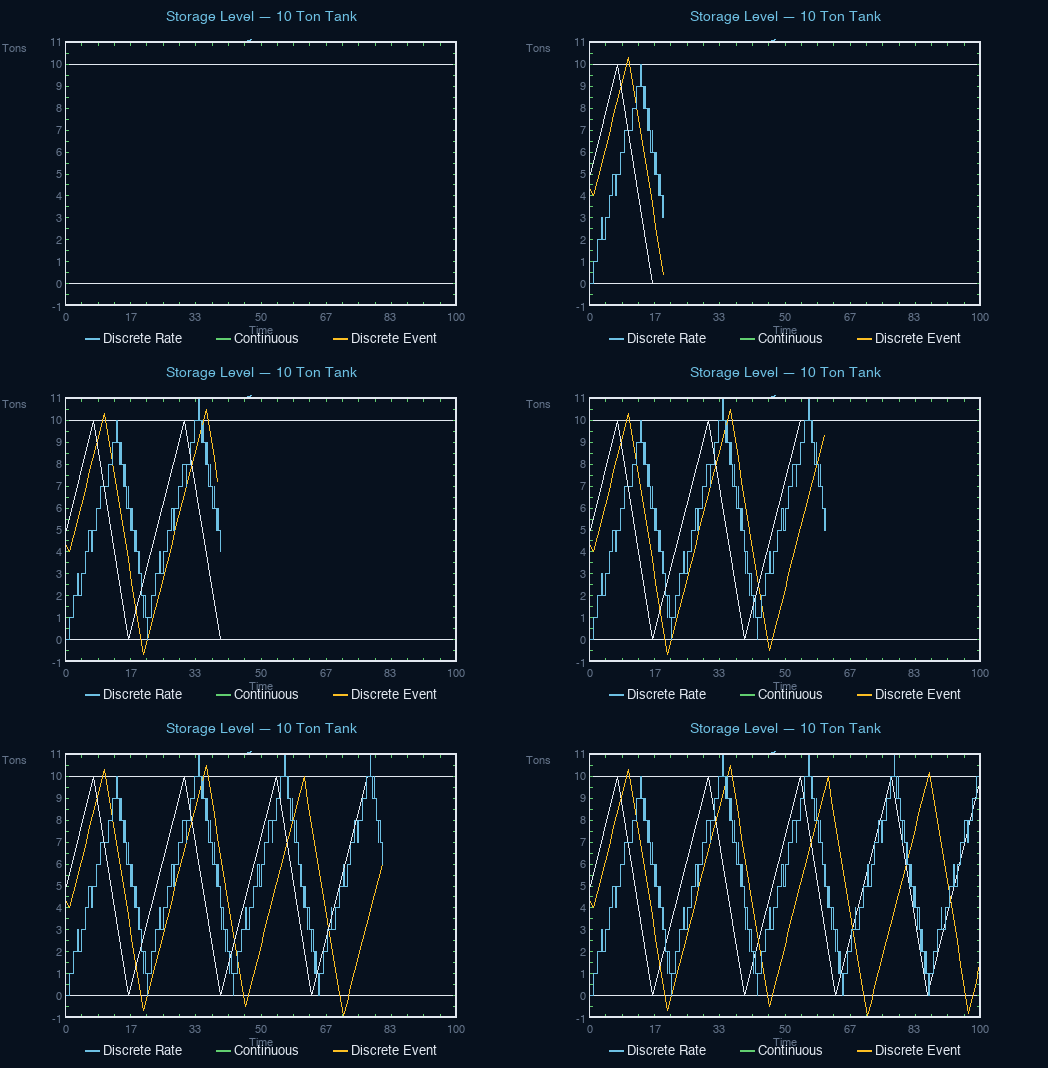

Animated comparison of continuous, discrete rate, and discrete event simulation tracking a tank level
The building blocks

Three primitives.
Any production system.

Every discrete rate model is built from three fundamental block types — first introduced by Andrew Siprelle in 1992 and now used by tens of thousands of practitioners worldwide.

Constraint
Constraint

The Machine

A process that moves or transforms material at a defined rate — a filler, capper, conveyor, pump, or any work center. Rate is primary; entities are not tracked individually.

Rate-based Throughput Changeover
Buffer
Buffer

The Storage

Inventory, tanks, accumulators, or conveyors between operations. Buffers absorb rate mismatches and decouple upstream failures from downstream starvation.

Accumulator Inventory Decoupling
Interrupt

The Event

Anything that changes a rate — a failure, jam, scheduled break, or wear event. Three types govern how and when a constraint resets back to running.

Competing Cumulative wear Wall clock
Competing

Resets after every stop regardless of cause. Models failures that compete to occur — the next one starts the clock fresh.

Cumulative Wear

Resets only on full restoration. Models stock depletion, lubrication cycles, mechanical wear — time accumulates across all stops.

Wall Clock

Triggered by scheduled time — shift end, lunch, CIL, calibration. Predictable, recurring, and independent of machine state.

The problem

Where traditional simulation
loses the plot.

Discrete Event Simulation was built for a different era. Push it into a modern high-speed line and three things fail — fast.

Event explosion

A 1,000 unit/min line fires millions of events per simulated hour. Models slow to a crawl or become unrunnable at production scale.

Fidelity loss

Micro-stoppages, blocking, starvation, and cascading failures get rounded away. What remains is a clean model of a messy reality that doesn't exist.

Wrong paradigm

High-speed lines don't behave like queues. They behave like flow networks under disruption. Modeling them as events is the wrong abstraction from the start.

The solution

What is Discrete Rate Simulation?

Continuous Flow
+
Interrupting Events
=
System State

Flow is primary. Events modify it. State evolves continuously — never approximated, never rounded.

Upstream
Blocked
1,200 → 0/min
Buffer
Full
decoupler
Interrupt
STOP
8.4 min TTR
Downstream
Starved
cascade effect
Output Rate
1,140
units/min
Buffer full →
upstream blocked
Absorbs
rate mismatch
Event
modifies flow
Cascade
loss
Actual
throughput
Side by side

How they differ.

Discrete Event Simulation
Discrete Rate Simulation
Each unit is an individual event
Flow is modeled as a rate, not unit-by-unit
Performance degrades with line speed
Complexity is independent of throughput rate
Micro-stoppages averaged away
Every interrupt modeled explicitly with TTF/TTR distributions
Blocking & starvation approximated
Flow propagation captures blocking and starvation exactly
Models validate at low speeds, fail at scale
Validated within 1% of actual production at full scale

"It would take me up to a month to develop a digital twin for a production line using traditional methods. ChiAha's discrete rate approach streamlines this process while still delivering high-quality results."

— Tom Lange, Technology Optimization & Management LLC · 36 years, Procter & Gamble · Co-author, "High Accuracy Discrete Rate and Reliability Modeling" (WSC 2020) · Validated within 1% OEE accuracy

Where it works

Built for these systems.

Anywhere high-speed flow meets real-world interruption — discrete rate is the right model.

🧴

Bottling & Packaging

High-speed filling, capping, and labeling lines where a 3-second micro-stop cascades through four downstream stations.

💊

Pharma Lines

Regulated, tightly coupled processes where every interruption must be modeled precisely for compliance and capacity planning.

🥫

Food Processing

Continuous-flow lines with sanitation windows, changeover events, and temperature-sensitive rate modifiers.

🤖

Automated Assembly

Robot cells, conveyors, and vision inspection stations where starvation and blocking are the primary throughput limiters.

🔬

Semiconductor & Electronics

Batch and flow processes with ultra-low cycle times and yield events that ripple through entire fab lines.

👁️

Vision-Enabled Systems

AI inspection stations that modulate line rate dynamically — a behavior discrete event tools simply can't represent.

The core mechanic

The Interrupt Construct.

Every machine failure is modeled as an interrupt — with its own statistical distribution for time-to-failure and time-to-repair. No averaging. No aggregation. The full competing-risk picture.

Filler A
94.2%
Filler B ←
81.3%
Capper
97.1%

Two fillers. Same total downtime. Filler B's frequent short stops create compounding starvation — and recover 220+ more minutes when fixed. That's what the interrupt construct reveals.

The real value

Most tools show you
what happened.
This shows you
what will happen if you change it.

What if we increase line speed by 5%?
1,200
Current
1,188
+5% speed
↓ Net gain suppressed by Filler B starvation
What if we fix Filler B's reliability first?
1,200
Current
1,347
Fix B first
↑ +12.3% effective throughput
What if we add a vision inspection station?
98.2%
Without
99.7%
With vision
↑ Quality yield at 1% speed reduction tradeoff
What if we change the buffer between stations 3 and 4?
14.2%
Starvation now
4.1%
+30 unit buffer
↓ 71% reduction in downstream starvation
Peer-reviewed

30 years of published research.

Discrete Rate Simulation has been validated, benchmarked, and extended across peer-reviewed publications since 1995 — from WSC to Springer to HMS proceedings.

View all 20 publications → chiaha.com/publications
The platform

Built in ReliaSim.

ReliaSim is the first platform purpose-built to execute Discrete Rate Simulation at production scale. No event overload. No approximation.

  • Model high-speed systems without event overload
  • Every interrupt has a full TTF/TTR distribution — no averages
  • Predict the impact of change before touching the real system
  • Independently validated within 1% of actual production
See ReliaSim → ChiAha
94.2%
OEE Predicted
1,138
Units/min Actual
4.9
Stops/Shift
Filler A97.1%
Filler B81.3%
Capper94.2%
Labeler98.8%
SIMULATION RESULT
Fix Filler B → recover +220 min/shift vs. identical downtime on Filler A