Discrete Rate Simulation calculates flow as rates instead of tracking every event. It fits any system with rates, constraints, and variability, from manufacturing to healthcare and logistics.
Invented by Andrew Siprelle in 1990.
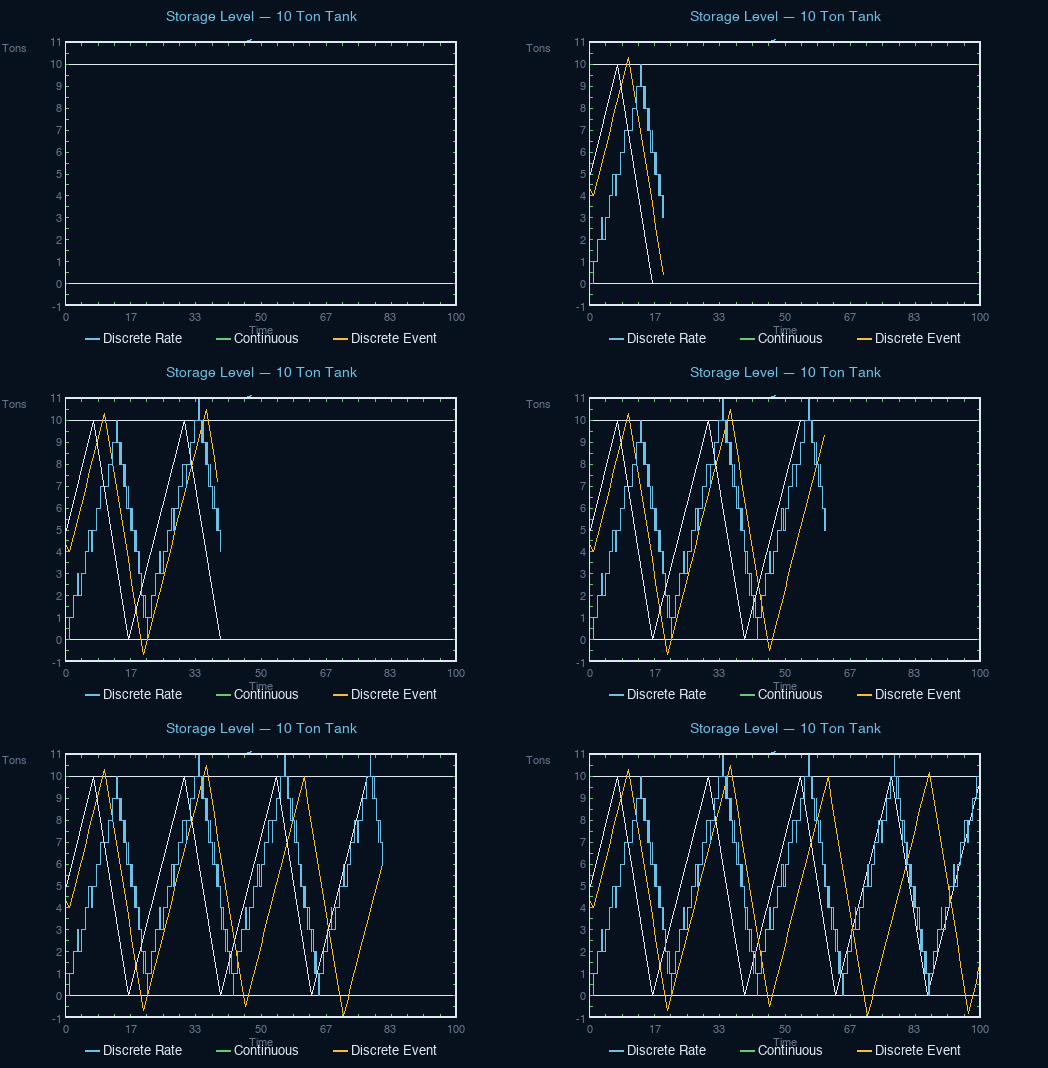
This simple example shows where the speed comes from. Discrete Event tracks every individual item — thousands of events for a single tank fill. Continuous recalculates at every time slice whether anything changed or not. Discrete Rate only fires when something actually changes: 4 events total — start, full, empty, end. Between events, the rate is constant. No recalculation needed. Scale that to a real system and the difference is orders of magnitude.
Play the same fill-then-empty scenario plus two more: the Hamburger Duo (5-stage DES vs DRS calibration) and the Valdez Tanker (items + flow in the same model).
Every discrete rate model is built from three fundamental block types — first introduced by Andrew Siprelle in 1990 and now used by practitioners worldwide.
Anything that moves or transforms material at a defined rate — a treatment stage, reactor, filling station, processing unit, or service point. Rate is primary; individual entities are not tracked.
Inventory, tanks, accumulators, or conveyors between operations. Buffers absorb rate mismatches and decouple upstream failures from downstream starvation.
Anything that changes a rate — a failure, jam, scheduled break, or wear event. Three types govern how and when a constraint resets back to running.
Multiple failure modes compete to occur. After any stop, the clock resets — the next disruption starts fresh. Models random breakdowns, surges, and unplanned events.
Triggered by time — shift changes, maintenance windows, planned outages. Predictable, recurring, and independent of process state.
Discrete Event Simulation tracks every item as its own event. On a modern high-speed line, that causes three problems.
A 1,000 unit/min line fires millions of events per simulated hour. Models slow to a crawl or become unrunnable at production scale.
Micro-stoppages, blocking, starvation, and cascading failures get rounded away. What remains is a clean model of a messy reality that doesn't exist.
High-speed lines don't behave like queues. They behave like flow networks under disruption. Modeling them as events is the wrong abstraction from the start.
Flow is primary. Events modify it. State evolves continuously — never approximated, never rounded.
"It would take me up to a month to develop a digital twin for a production line using traditional methods. ChiAha's discrete rate approach streamlines this process while still delivering high-quality results."
— Tom Lange, Technology Optimization & Management LLC · 36 years in manufacturing R&D · Co-author, "High Accuracy Discrete Rate and Reliability Modeling" (WSC 2020)
If things flow through your system at a rate, and interruptions disrupt that flow — discrete rate is the right paradigm.
High-speed filling, capping, and labeling lines where a 3-second micro-stop cascades through four downstream stations.
Regulated, tightly coupled processes where every interruption must be modeled precisely for compliance and capacity planning.
ED arrivals, bed turnover, discharge rates, shift changes. The constraint shifts by hour — simulation reveals which interventions matter when.
Reactors, distillation columns, heat exchangers. Progressive rate degradation from fouling is an interrupt — not just on/off failures.
Treatment stages with scheduled backwash cycles, seasonal demand variation, and parallel unit constraint shifts.
Combined cycle plants with rated outputs, forced outages, and partial derating — the system doesn't stop, but the constraint tightens.
Continuous flow with CIP cycles, quality windows, and cold chain constraints. Buffer sizing isn't just throughput — it's product integrity.
Batch and flow processes with ultra-low cycle times and yield events that ripple through entire fab lines.
Compressor stations, metering points, line pack as buffer. When a compressor trips, the pipeline is a constraint system.
Small-batch production with tight quality windows, long changeovers, and cure times. Rate shifts with composition; yield events behave like scheduled interrupts.
Trucks, rail, or mobile equipment as a system. Vehicle availability is the constraint; maintenance cycles, refueling, and driver hours behave exactly like interrupts on a line.
Every disruption is modeled as an interrupt — with its own statistical distribution for time-to-failure and time-to-repair. Nothing is averaged or aggregated, so you see the full competing-risk picture.
Two fillers. Same total downtime. Filler B's frequent short stops create compounding starvation — and recover 220+ more minutes when fixed.
Discrete Rate Simulation has been validated, benchmarked, and extended across peer-reviewed publications since 1995 — from WSC to Springer to HMS proceedings.
The DiscreteRate paradigm powers ReliaSim, a manufacturing-deep simulator, and a free web-based Decoupling Buffer Simulator. ChiAha, the company behind both, builds and runs models with your team.
Manufacturing-deep simulation with detailed failure modes, TTF/TTR distributions, blocking/starving analysis, and Gain ≠ Loss experimentation.
Free, web-based discrete rate simulation for decoupling buffer design. Explore production lines with buffers, breakdowns, and speed variance. No login — test any scenario in your browser.
The company behind DiscreteRate and ReliaSim. Simulation and operations-research consulting for manufacturing and supply chains, from a single line study to a whole plant.
Product updates and new case studies by email. Unsubscribe any time.